I am writing this from a Kinko's somewhere in the wilds of Mallville, USA
Due to a major meltdown of my pc, I probably won't be posting much here in the next week or so. Four hours on the phone to Windows' Yogi in India semed to have solved the problem at first, but after hanging up, when I restarted pc, all went even more haywire.
The error messge I NOW get on my own pc reads as follows: "a required DLL file was not found, c:\windows\system\wapi.dll was not found"; then, "error loading exe. you must reinstall windows." As far as I am aware, reloading Windows would wipe entire everything, so.....
I will be taking Mr. PC to the shop (comp usa?) within the next few days, meanwhile, if anyone has any thoughts regarding a solution, It would be nice to hear from you at cllr1@comcast.net.
Best,
Bill Reed
My web site
Sunday, March 27, 2005


Saturday, March 26, 2005
Queen Leer
Yesterday, I burned a CD of 78 rpm recordings by the long-ago diseur and musician Dwight Fiske for the son of a late, lamented comedy genius. He'd told my good friend and constant traveling companion of the last 35 years, David Ehrenstein---they are journalists and colleagues at an L.A. newspaper---that his dad had recommended Fiske highly, and yet he had never been able to find any recordings by him. I wanted to write a note to accompany the CD that would place Fiske into socio-cultural perspective. I did so, and by the time I finished, I realized that I had also written my blog entry for today (as my grandmother used to say, re: not wasting anything: "Everything but the oink."). Here's what I wrote to him:
Inasmuch as Dwight Fiske recorded in excess of a hundred sides circa 1935-'45, one would think there would be something available. Yet he is one of those once-famous public figures, like authors James Branch Cabell and Carl Van Vechten, who have simply fallen through the cracks of cultural history, rarely, if ever, to be heard from again.
Some of the tracks on the CD I made are not listed in a brief bio of Fiske and (seemingly) exhaustive discography---with titles like: "Two Horses and a Debutante," "Africa Whispers," "Coney Island Honeymoon," "Puss in the Corner," "Senorita Margarita Del Campo---to be found here. Which leads me to wonder just how much more Fiske actually recorded.
The rubric under which these risque releases were presented to the American record buying public was "Party Records." Presumably, they were sold----"Psssst--- under the counter. One friend of Fiske's recalled:
"In that era [the 1930s], a young lady had not experienced living if she had not seen Dwight Fiske. At every party you went to, you had to hear one of his records."
A fair amount of Fiske's material was written by the wonderful novelist (and friend of Fiske's) Dawn Powell. Fiske even appears as a character in one of her novels. . . as a woman. According to urban legend, he was somewhat miffed at his involuntary "sex change" and complained to Powell, "You've turned me into a woman!" To which Powell reportedly replied, "It isn't the first time that's happened and it won't be the last."
An explique du texte reveals that an awful lot of Fiske's material related to the phenomenon of. . . size, as in "size queen." Apparently he went against the tide of latter-day sentiment and felt that penile dimension decidedly DID matter.
In his book Intimate Nights: The Golden Age of Cabaret, James Gavin writes:
"Fiske's stories told of such characters as Pomona the Deer, a charming doe out to make an honest buck; Queen Isabella, whose frustrations grew unbearable during Columbus's long absences ("She didn't give a damn whether the earth was flat or round!"); and Salome, so driven with desire for John the Baptist that she performed the dance of her life in order to seduce him. "Which only goes to prove," declared Fiske, "that if you want something long enough. . .and you want it hard enough. . .you're bound to get it in the end [emphases Fiske's].
Many of Fiske's tales ---all were delivered unsung, singspiel-fashion---were published in his collections Without Music in 1933 and Why Should Penguins Fly? in 1934.
The former had a foreword by Robert Benchley who writes of Fiske as "one of our most literate writers of humorous prose" whose humor "is based on characterization and a choice of words" and "a skilful utilization of emphasis."
Admittedly, Fiske's art has not---to put it mildly---aged well, and it is hard to believe that anything so tame could have at one time been considered so nudgenudgewinkwink. But his self-accompanied (piano) monologues do still manage to possess a certain charm and interest, if for no other reason than his "literate" (per Benchley) way with words. For a sample of Dwight Fiske, click here (link removed)
My web site
Inasmuch as Dwight Fiske recorded in excess of a hundred sides circa 1935-'45, one would think there would be something available. Yet he is one of those once-famous public figures, like authors James Branch Cabell and Carl Van Vechten, who have simply fallen through the cracks of cultural history, rarely, if ever, to be heard from again.
Some of the tracks on the CD I made are not listed in a brief bio of Fiske and (seemingly) exhaustive discography---with titles like: "Two Horses and a Debutante," "Africa Whispers," "Coney Island Honeymoon," "Puss in the Corner," "Senorita Margarita Del Campo---to be found here. Which leads me to wonder just how much more Fiske actually recorded.
The rubric under which these risque releases were presented to the American record buying public was "Party Records." Presumably, they were sold----"Psssst--- under the counter. One friend of Fiske's recalled:
"In that era [the 1930s], a young lady had not experienced living if she had not seen Dwight Fiske. At every party you went to, you had to hear one of his records."
A fair amount of Fiske's material was written by the wonderful novelist (and friend of Fiske's) Dawn Powell. Fiske even appears as a character in one of her novels. . . as a woman. According to urban legend, he was somewhat miffed at his involuntary "sex change" and complained to Powell, "You've turned me into a woman!" To which Powell reportedly replied, "It isn't the first time that's happened and it won't be the last."
An explique du texte reveals that an awful lot of Fiske's material related to the phenomenon of. . . size, as in "size queen." Apparently he went against the tide of latter-day sentiment and felt that penile dimension decidedly DID matter.
In his book Intimate Nights: The Golden Age of Cabaret, James Gavin writes:
"Fiske's stories told of such characters as Pomona the Deer, a charming doe out to make an honest buck; Queen Isabella, whose frustrations grew unbearable during Columbus's long absences ("She didn't give a damn whether the earth was flat or round!"); and Salome, so driven with desire for John the Baptist that she performed the dance of her life in order to seduce him. "Which only goes to prove," declared Fiske, "that if you want something long enough. . .and you want it hard enough. . .you're bound to get it in the end [emphases Fiske's].
Many of Fiske's tales ---all were delivered unsung, singspiel-fashion---were published in his collections Without Music in 1933 and Why Should Penguins Fly? in 1934.
The former had a foreword by Robert Benchley who writes of Fiske as "one of our most literate writers of humorous prose" whose humor "is based on characterization and a choice of words" and "a skilful utilization of emphasis."
Admittedly, Fiske's art has not---to put it mildly---aged well, and it is hard to believe that anything so tame could have at one time been considered so nudgenudgewinkwink. But his self-accompanied (piano) monologues do still manage to possess a certain charm and interest, if for no other reason than his "literate" (per Benchley) way with words. For a sample of Dwight Fiske, click here (link removed)
My web site
Friday, March 25, 2005
Cat blog Friday #8
Kuro and Ming Toy 

Kuro is David Ehrenstein's (and my) cat, Kuro. (Did you know, btw, that the French have no word for "pet"?) Kuro is seen here in 2005 with Ming Toy, whom David named after. . . "I don't remember. I was three. It was a name I heard somewhere." Fairly precocious for a three-year-old back in 1950, and I am happy to report that David hasn't changed much since then.
David and Ming Toy are now both settling gracefully into. . .un certaine age. They've been through a lot together. Like the time when David, with his parents, visited San Francisco on vacation and he forgot Ming Toy back at the hotel (the Fairmont, of course). The oversight wasn't noticed, however, until they were prrrractically at the Continetal Divide on their auto journey back to Queens, New York. At which point, they had to turn around and drive all the way back to S.F. to retrieve Ming. David learned his lesson and never forgot Ming Toy again; and in the immortal words of Carol Burnett's Mildred Fierce: "Kids! They sure keep ya hoppin'!" So do cats.
My web site
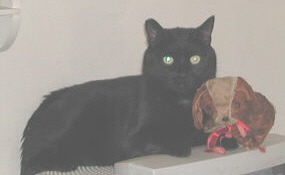
Kuro is David Ehrenstein's (and my) cat, Kuro. (Did you know, btw, that the French have no word for "pet"?) Kuro is seen here in 2005 with Ming Toy, whom David named after. . . "I don't remember. I was three. It was a name I heard somewhere." Fairly precocious for a three-year-old back in 1950, and I am happy to report that David hasn't changed much since then.
David and Ming Toy are now both settling gracefully into. . .un certaine age. They've been through a lot together. Like the time when David, with his parents, visited San Francisco on vacation and he forgot Ming Toy back at the hotel (the Fairmont, of course). The oversight wasn't noticed, however, until they were prrrractically at the Continetal Divide on their auto journey back to Queens, New York. At which point, they had to turn around and drive all the way back to S.F. to retrieve Ming. David learned his lesson and never forgot Ming Toy again; and in the immortal words of Carol Burnett's Mildred Fierce: "Kids! They sure keep ya hoppin'!" So do cats.
My web site
Wednesday, March 23, 2005
Kenzo Tange
Fuji-Sankei Headquarters, Tokyo
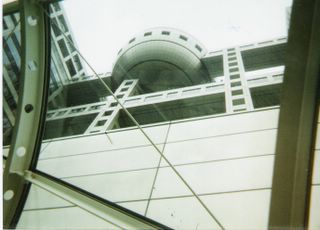
The great Japanese architect Kenzo Tange died Tuesday in Tokyo at age 91. Several days of my last trip to that city, in April, were spent taking a tour of Tange's Tokyo. More than any other living architect I can think of, Tange embodied that which critic Geoffrey Scott, in his famous 1914 book The Architecture of Humanism, deemed to be the three most important criteria of the art of building, i.e. firmness, commodity and delight. That is to say, well-built, spacious, and playful.
Even though Scott, who died in 1929, preceded most of what we think of as "modern architecture," I can't help but think he would have been pleased by much of Tange's work, especially his 1991 Fuji Broadcasting headquarters on the Island of Odaiba in Tokyo Bay. The first time I laid eyes on it, in 2001, it took my breath away. There is no way that two-dimensional, still photographs can do full justice to it, nevertheless here is one the many details I have taken of the 25-story structure, whose playful proportions are meant to replicate those of a Hi-Def TV screen. Some other photos of the Fuji headquarters and more of Tange's works can be seen here. As they say. . .a big loss.
My web site

The great Japanese architect Kenzo Tange died Tuesday in Tokyo at age 91. Several days of my last trip to that city, in April, were spent taking a tour of Tange's Tokyo. More than any other living architect I can think of, Tange embodied that which critic Geoffrey Scott, in his famous 1914 book The Architecture of Humanism, deemed to be the three most important criteria of the art of building, i.e. firmness, commodity and delight. That is to say, well-built, spacious, and playful.
Even though Scott, who died in 1929, preceded most of what we think of as "modern architecture," I can't help but think he would have been pleased by much of Tange's work, especially his 1991 Fuji Broadcasting headquarters on the Island of Odaiba in Tokyo Bay. The first time I laid eyes on it, in 2001, it took my breath away. There is no way that two-dimensional, still photographs can do full justice to it, nevertheless here is one the many details I have taken of the 25-story structure, whose playful proportions are meant to replicate those of a Hi-Def TV screen. Some other photos of the Fuji headquarters and more of Tange's works can be seen here. As they say. . .a big loss.
My web site
Subscribe to:
Posts (Atom)