Tuesday, September 13, 2005

What a day!

Posted by Picasa

For a lover, such as myself, of the Great American Songbook and its singing jazz-inclined practitioners, yesterday was quite a day. In exactly one shipment of U.S. mail I received:

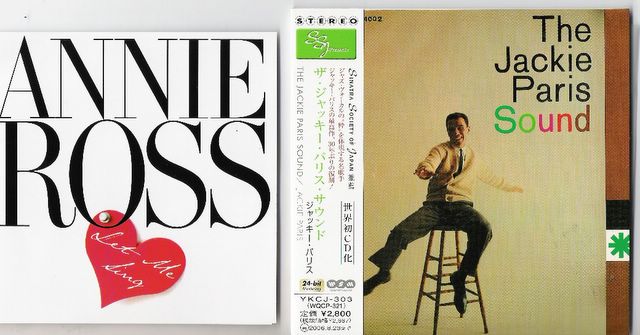
1.) The new Japanese CD reissue from The Frank Sinatra Society of Japan,
The Jackie Paris Sound

2.) The new Annie Ross CD, Let Me Sing

3.) A copy of a Japanese jazz magazine featuring an article about Wild and Wonderful West Virginia jazz singer (now retired) Jennie Smith


And last but not---if anything was ever not--- least. . .

4.) A rare tap dance 78 rpm tap dance instruction record sung by my all-time favorite, Beverly Kenney. Signed, yet! It was given to me by a close friend of Kenney, who died in 1960. Holding the unopened box containing the 78, my hands were shaking almost uncontrollably, both from the fear that the fragile disc might have cracked in transit from Florida or else that I would inflict similar damage when I opened it. Gakkk! But all is well, and maybe when I get it transferred I might put a portion of it up here as an mp3.

As for the new Annie Ross CD, it was cut in August. This is the way she sounds now, and according to the New York reviews of her current date at Danny's Skylight Room in NYC, she still looks beyond fabulous. When you hear the CD you will understand why trumpet player Warren Vache is working with her. Her voice, as some seem to be somewhat tiresomely pointing out, is "not what it once was" (but they don't care), and that might be true. But if so, Vache goes a long way on the recording--and presumably in person at Danny's---in offsetting this with all his brilliant fills, filigrees and obbligatos around Annie's singing. It is a brilliant combination. So many lovely things about the CD. The acappella version of Nobody's Heart, Lush Life...well, it is just terrific. And she is a great star! I love this CD!

A couple of weeks ago I received an email, prompted by my blog, from a Japanese jazz critic. He wrote:

Dear Mr. Bill Reed,

How do you do. I am a Japanese writer and also a physician. I was very much surprised and highly pleased to find Jennie Smith's information in your blog recently. Like you, I also have been searching to find out about how she is getting along. In addition to the access of internet, I have tried every possible means such as making an inquiry to the former far-east manager of Dot records. But, it was in vain. I am a strong fan of Jennie Smith here in Japan. I have four LPs of her own. I have been fascinated by her precise, clear, extended, and even charming voice. I am also a writer and in 2004, I introduced her as a wonderful vocalist to Japanese jazz fans. I feel she has been underrated. Thank you very much for your efforts to find her. By way of showing appreciation, I would like to send you my article about Jennie Smith if you let me know your address. Also, if it is OK, please send one more issue to issue to Jennie Smith. Anyway, I am very happy to know that she is living right in L.A. I am waiting for your reply. Thank you

Yesterday I received the mags, had the very sweet article translated and sent it off to Ms. Smith.. . .even in the midst of all the other excitement (see above). I trust she will enjoy it.

As for the 1958
Jackie Paris Sound, long out-of-print but now restored to circulation, it is simply one of the ---pardon the adjectival overkill---greatest jazz vocal albums I have ever heard. Yesterday, I was happy to be able to throw my old taped copy away and finally hear it in all its digitally remastered glory from the SSJ of Japan. Kind of pricey I guess, but worth every penny. And what an honor to have two records that I produced, by singers Pinky Winters and Bill Black, issued in the same first wave of five SSJ releases as the Jackie Paris.

Sunday, September 11, 2005

Tukufu who?

I watched a segment of the PBS History Detectives tonight. Especially engrossing were the peregrinations gone through by one exotically-monikered HD regular, Tukufu Zuberi (If I---Bill Reed---had a name like that, I could die happy), to unravel the provenance of some signed WW II Japanese internment camp watercolors. I must admit that I was held captive---so to speak---by TZ's back-and-forth flights across the U.S., racking up gazillions of frequent flyer miles in his search to uncover the "mystery" of the delicate renderings. And I'll confess that my jaw dropped to the floor on more than one occasion as this road show Miss Marple peeled away subsequent layers of the picaresque tale.

The segment concludes with our inveterate sleuth, mit camera crew in tow, knocking on the door of a certain George Tamura in Washington state and revealing to him the portfolio of ten or so watercolors that he had painted more than sixty years ago while confined as a fifteen-year-old in the Tule Lake, CA camp and had not seen since then. Kinda brought a tear to the old eye.

Ultimately, though, I feel a tad had, because after HD was over I was able to immediately trot over to my pc and, with a mere two strokes of the keyboard on Google, i.e. "George T. Tamura" + "internment," solve the self-same so-called mystery.

It seems that Tamura-san had taken his reparations from the 1990 internment U.S. government settlement and self-published a book, Reflections, on his experiences as a detainee. Existence of which has been noted on the net for years in advance of the recent HD segment. (I wonder if this is the same GTT who wrote Smoke Control for High Rise Building Fires AND co-wrote Pressure Drop Characteristics of Typical Airshafts in High-Rise Buildings? Tukufu?. . . Anyone?)

To paraphrase the immortal words of the equally immortal Thelma Ritter in All About Eve, "What a story! Everything but the hound dogs yapping at his [Tukufu's] rear end." Maybe they should call the program "History Drama Queens" instead.

Makes me think of that old joke: Q. "What's a WASP's idea of a good time?" A. "Getting over a head cold." I guess I'm just no fun!

Wednesday, September 07, 2005

Anatomy of a Bonus Track

Posted by Picasa


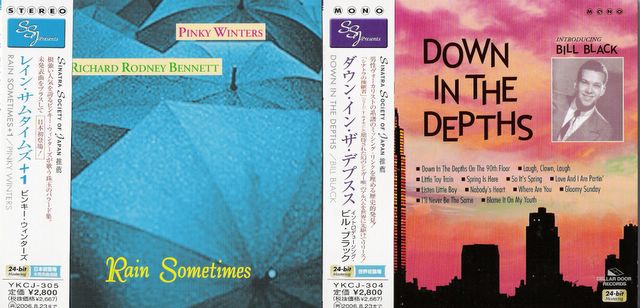
I'm always suspicious when a bonus track pops up on an album a few years after its original release; my first thought is always, “Well, why wasn’t it on there in the first place?” I feel like I’m being “had,“ and that the new track has just been added in an attempt to make me buy the album all over again. But in the case of the terrific cut, “The Lamp is Low,” included on the Japanese Fall 2005 RE-release of Rain Sometimes, by Pinky Winters and Richard Rodney Bennett that I produced in 2001, nothing could be further from the truth. Here’s the “real” story behind the addition, and while we’re at it, some background on the making of the album might also be in order.

My original plan in 2001 was to record the album, hop on a plane to Japan and sell the master to the highest bidder. Winters was and IS quite well known there, far more so than in the States. In between the recording of the CD and my scheduled flight, however, 9/11 happened and by the time I was eventually able to get to Japan, most of my label meetings had been cancelled, never again to be rescheduled. But I’m getting ahead of myself.

Through no fault of Bennett, Winters or myself, at least the first day of recording of the CD was fairly much a nightmare. And if it had not been for Bennett, the project might never have been completed. Throughout the first three hours of the initial day, the breathtakingly inept staff of the studio where the CD was recorded kept topping themselves in the inefficiency department.


Finally, I went up front to the office of the owner and told him in no uncertain terms that he had better shape up or WE would ship out. When the two of us reached the studio, Bennett, in high apoplexy, told him off in no uncertain terms. And within one minute---no exaggeration---the problem that had held us up for hours was solved by the clueless, but not entirely technically inept proprietor. Later that day, he asked me:

"What's that guy's name and just who the hell does he think he is talking to me that way?"

"He is SIR Richard Rodney Bennett."

"Sir?!?!? How did he get to be a sir?"

"I suppose," I said, "by doing his job and having a sense of responsibility toward the rights and feelings of others." ("Unlike you" was my implied undertone.)

But the gumby could only respond with a distracted, "Doh."

All of this came as a great shock to me inasmuch as the studio was one of the highest-priced in L.A., with a long, impressive history and a top of the line Boesendorfer piano. I had an expensive, multiple gold disc-winning engineer at the controls, and had booked more than adequate time---18 hours---in which to record the CD. Fortunately, the second and third days proceeded without serious incident. Little did I realize it at the time, but the "fun" was just beginning.

Eventually, I was able to lease the master of the recording to a major Japanese record label, but within a short time they reneged on the deal to release the CD and I had to "eat" my fairly substantial advance in order to hold on to my rights in that country. The label’s failure to honor the contract had nothing to do with the quality of the album. I was later to learn that after the recent death of the label’s president, a radical shift away from releasing American recordings to, instead, strictly Japanese recordings was the new order of the day for those who had taken over in the wake of the death of the label prexy. After that, Winters and Bennett graciously agreed to let me issue the CD myself in the U.S.; thus was born my Cellar Door Records.


I'm still significantly in the hole even after my recent licensing of the CD to Japan. So I'm glad that I held on to my rights there. There were other problems as well attendant to the making of the recording---"What! And give up show biz?"---but they are perhaps saved for some long, cold winter’s night around the campfire.

And NOW to the business at hand: The reason that "The Lamp is Low" didn’t appear on the original U.S. issue is as follows:

"Lamp" on my protection master in the U.S. turned out to be flawed, but the Japanese were taking so long in sending me back the original master, that I just went ahead and issued the CD in the U.S. on Cellar Door under the title Rain Sometimes, sans "Lamp" (The Lamp is Low was to have been the CD’s original title). Eventually, I got my original (perfect) master back, thus enabling me to reissue the CD with "Lamp" as a bonus track on August 24, 2005, somewhat ironically

. . . in Japan.

One of the things I began to suspect after producing "Rain," is that there is, perhaps, a sturm und drang saga of near-epic proportions behind nearly every CD set out in the bins at your local record emporium. Finally, however, despite some passing moments of unpleasantness in its making, Rain Sometimes is, I think, a wonderful album.

Now it is being released in the country, Japan, for which it was intended. . . along with another recording for which I was the Release Producer, Down in the Depths by
Bill Black.

Rain Sometimes and
Down in the Depths are available through Cellar Door Records at www.amazon.com. Per usual for Japanese imports, the prices are a bit steep, but nowhere near the vertigo-inducing tariff that other sellers are charging at amazon.com and other cyber commerce sites.

Friday, September 02, 2005

Cat Blog Friday

CBF Posted by Picasa

The Littlest Hanshin Tiger